Soybean Oil Production Line in Zambia

Zambia has strong potential for soybean oil production due to its expanding soybean farming sector, growing demand for edible oils, and increasing need for locally produced soybean meal for animal feed. Soybean processing has become an important part of Zambia’s agro-processing industry, with major processing activities concentrated around regions such as Lusaka, Central Province, and the Copperbelt.
A complete soybean oil production line in Zambia can produce:
- Refined soybean cooking oil
- Crude soybean oil
- Soybean meal for livestock feed
- Soybean hulls and other by-products
Existing soybean processing facilities in Zambia include operations with seed preparation, crushing, extraction, refinery, cake handling, and packaging sections.
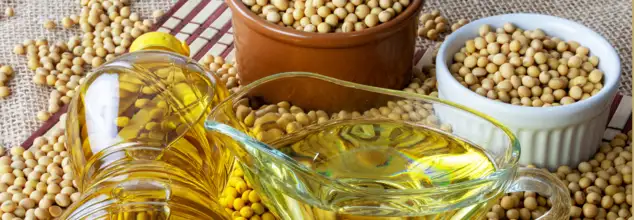
Complete Soybean Oil Production Process
A complete soybean oil production line transforms raw soybeans into high-quality edible soybean oil and valuable soybean meal through four major stages:
Phase 1: Cleaning & Pre-Treatment (Preparation)
Before any oil can be extracted, the beans must be thoroughly cleaned and physically altered. Processing raw, whole beans results in very low yields and heavily damages processing machinery.
- Cleaning & De-stoning: Raw soybeans pass through vibrating screens, aspiration channels, and magnetic separators. This removes field trash, stalks, dust, stones, and stray metal pieces.
- Drying: If the incoming beans have a high moisture content, they are passed through a grain dryer to reduce moisture to roughly 10% to 11%, which is ideal for mechanical cracking.
- Cracking & Dehulling: Heavy corrugated roller mills crack each bean into 4 to 8 smaller pieces. An aspiration system then uses air suction to pull away the lightweight outer hulls (skins). Removing the fiber-rich hulls prevents them from absorbing oil during extraction and ensures the final leftover meal has a higher protein concentration.
- Conditioning (Cooking): The cracked, dehulled bean pieces are heated in a rotary steam conditioner to roughly 70°C to 75°C. This thermal treatment softens the bean tissue, adjusts internal moisture, and reduces oil viscosity.
- Flaking: The warm bean pieces pass through smooth, high-pressure flaking rollers that flatten them into incredibly thin flakes (around 0.25 to 0.30 mm thick). This mechanical flattening ruptures the microscopic plant cell walls, exposing the internal oil pockets for extraction.
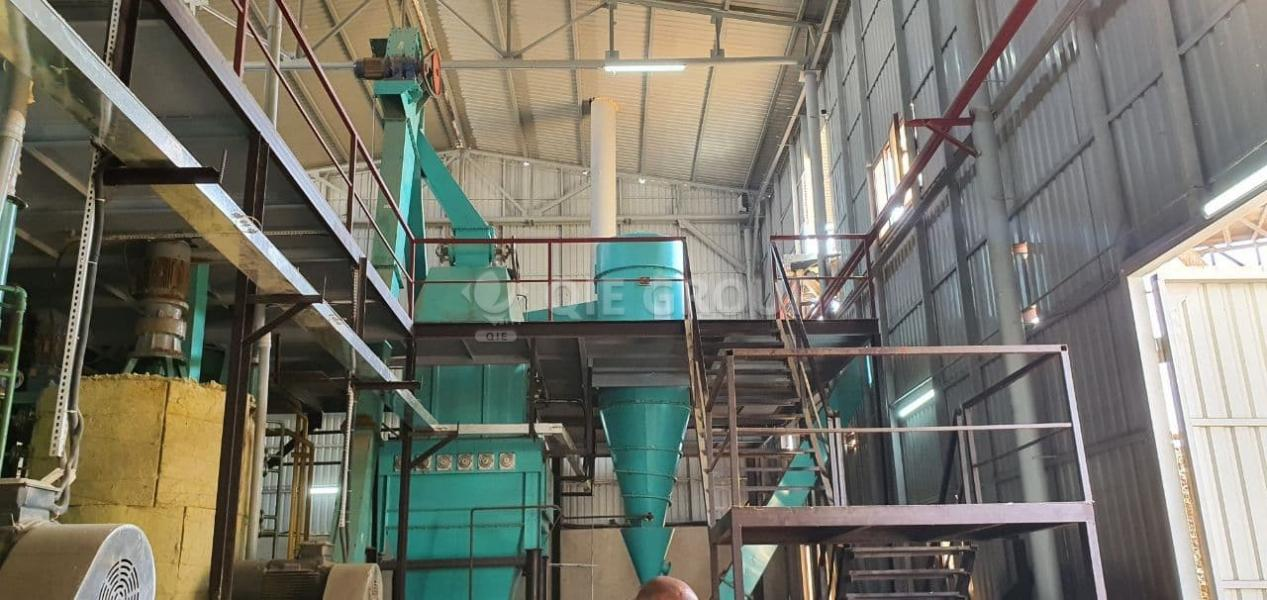
Phase 2: Oil Extraction
Depending on the processing plant’s physical capacity and capital budget, the oil is extracted from the flakes using one of two completely different industries methods:
Method A: Mechanical Pressing & Extrusion (Small to Medium Scale, <30 Tons/Day)
- Extrusion (Puffing): The thin flakes pass through a high-friction screw extruder. Mechanical friction instantly drives temperatures up to 130°C–150°C. This flash-cooks the soy, completely breaks down cell structures, and deactivates anti-nutritional factors.
- Screw Pressing (Expelling): The hot, extruded material is fed directly into a continuous mechanical screw press. A heavy rotating screw forces the material down a narrowing barrel, squeezing the liquid oil out through tiny slots. The remaining compressed solids exit the end of the press as a dense oil cake containing roughly 6% to 8% residual oil.
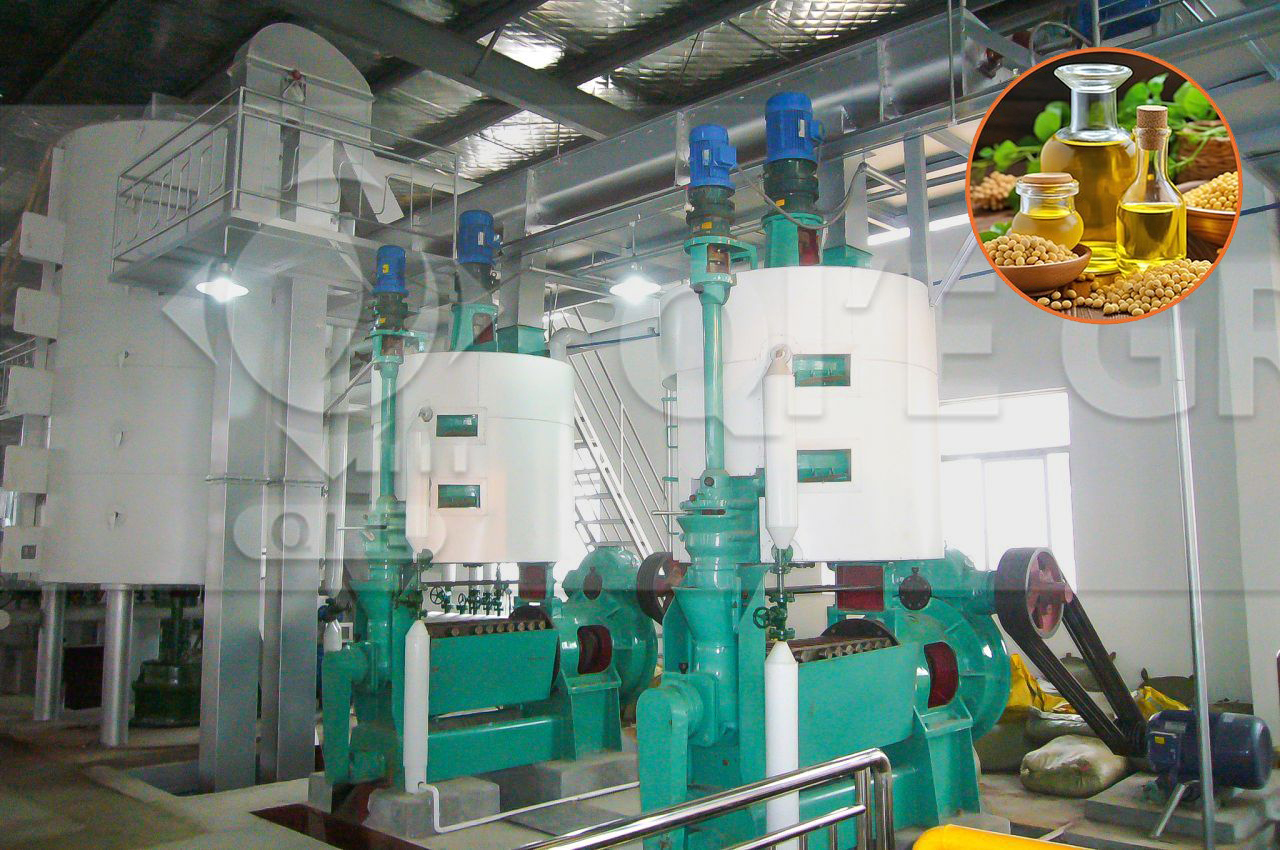
Method B: Solvent Extraction (Large Industrial Scale, >50 Tons/Day)
- Hexane Washing: The prepared flakes are sent to a sealed chemical extractor, where they are washed continuously with a food-grade chemical solvent, typically N-Hexane. The solvent acts as a chemical magnet, dissolving and extracting nearly all available oil.
- Desolventizing the Meal: The leftover wet meal flakes are sent to a Desolventizer-Toaster (DT) unit, where steam strip-heats the meal to evaporate and safely recover the hexane. This leaves a high-purity soybean meal with less than 1% residual oil.
- Evaporating the Miscella: The oil-and-solvent mixture (called miscella) is pumped through a series of vacuum evaporators and stripping columns. The solvent evaporates at a low temperature, is condensed back into a liquid for reuse, and leaves behind pure crude soybean oil.
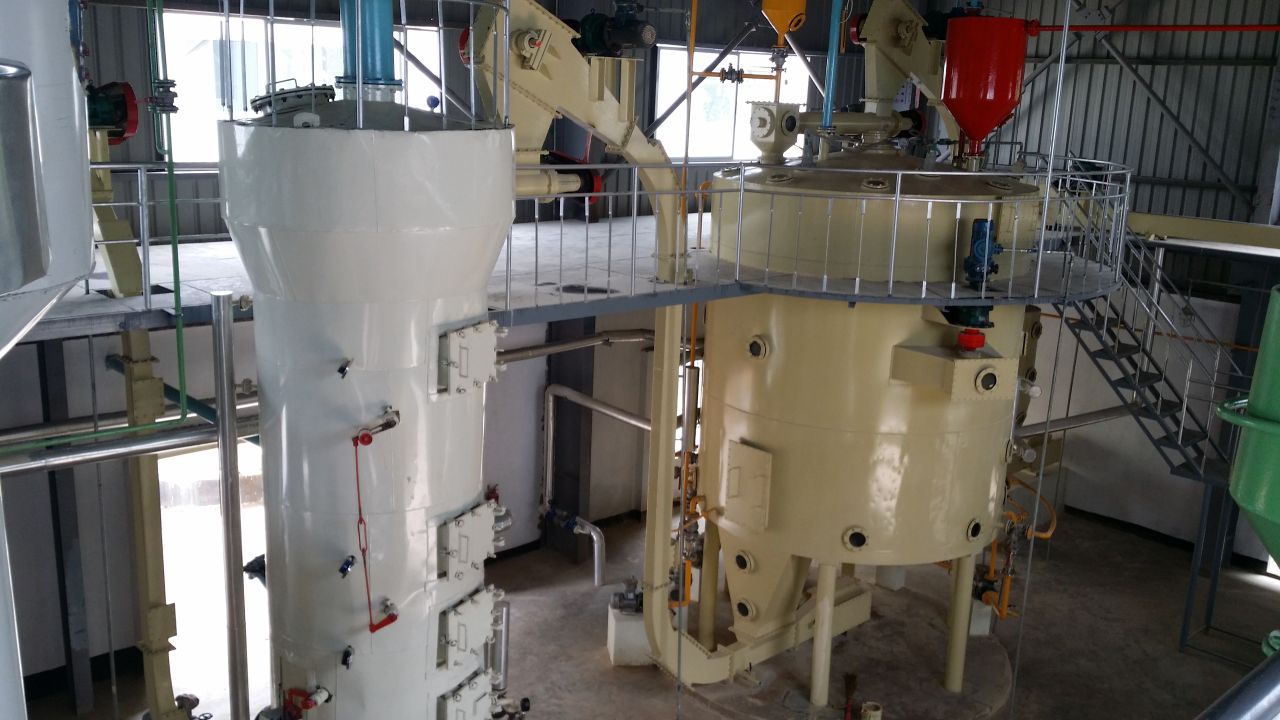
Phase 3: Crude Oil Refining (Edible Oil Processing)
Crude soybean oil is dark, cloudy, and contains natural impurities like phospholipids (gums), free fatty acids, and pigments. If you try to cook with crude oil, it will smoke heavily and spoil quickly.
To make it a retail-grade cooking oil, it must pass through an RBD (Refining, Bleaching, Deodorizing) line:
- 1. Degumming: The crude oil is mixed with hot water or food-grade phosphoric acid. This hydrates the phospholipids (gums), causing them to clump together so they can be separated out using centrifugal separators.
- 2. Neutralization (Deacidification): Sodium hydroxide (an alkali solution) is mixed into the oil to react with free fatty acids. This process turns the bitter acids into a dense soap stock, which settles out and is pumped away.
- 3. Bleaching (Decolorization): The neutralized oil is stirred with an adsorbent material, such as activated clay or bleaching earth, under a vacuum. The clay absorbs dark chlorophyll and carotenoid pigments, neutralizing the oil’s color to a light, golden yellow. The clay is then caught and removed by a leaf filter press.
- 4. Deodorization: The bleached oil undergoes high-temperature steam distillation (roughly 240°C to 260°C) inside a deep vacuum tower. This strips away volatile compounds, off-flavors, and odors, resulting in a completely odorless, crystal-clear, and highly shelf-stable commercial cooking oil.
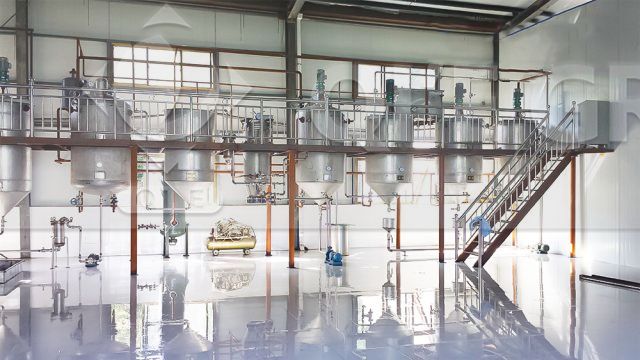
Recommended Plant Capacities for Zambia
Small Soybean Oil Mill (1–10 TPD)
Suitable for:
- Farmers’ cooperatives
- Small edible oil brands
- Local markets
Configuration:
- Soybean cleaner
- Small oil expeller
- Filter press
- Simple refinery (optional)
Advantages:
- Low investment
- Easy operation
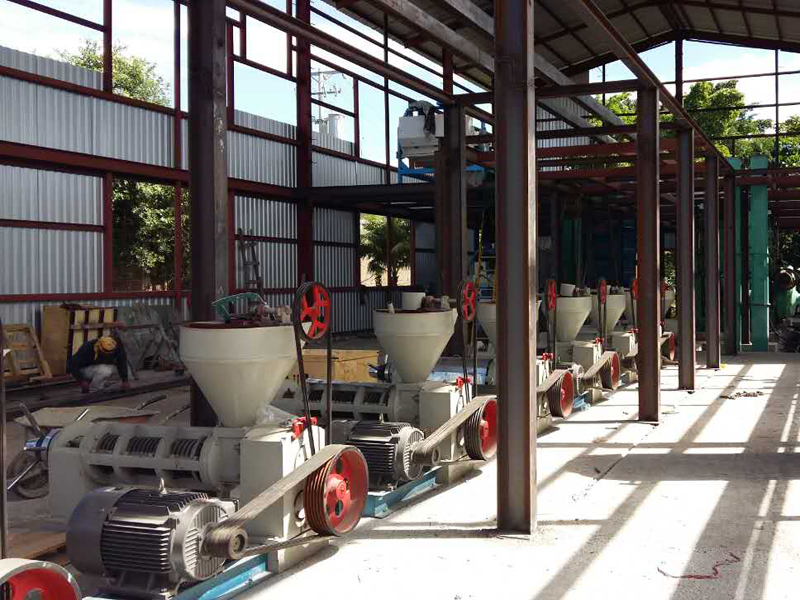
Medium Soybean Oil Plant (20–100 TPD)
Suitable for:
- Commercial oil producers
- Regional distribution
Typical configuration:
- Pretreatment system
- Screw pressing line
- Oil filtration
- Refinery section
- Oil filling system
A 40 TPD soybean processing plant has been installed in Zambia using cleaning, destoning, cracking, extrusion, oil pressing, filtration, and cake processing sections.
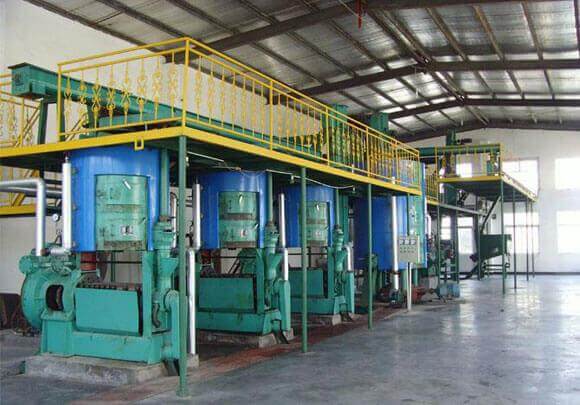
Large Soybean Crushing Plant (100–1000+ TPD)
Suitable for:
- Industrial investors
- Export-oriented businesses
Includes:
- Large soybean storage silos
- Full pretreatment system
- Solvent extraction plant
- Refinery plant
- Feed production line
- Automated control system
A 100 TPD soybean oil mill project in Zambia included soybean pretreatment, solvent extraction, refining, oil packaging, and feed processing facilities.
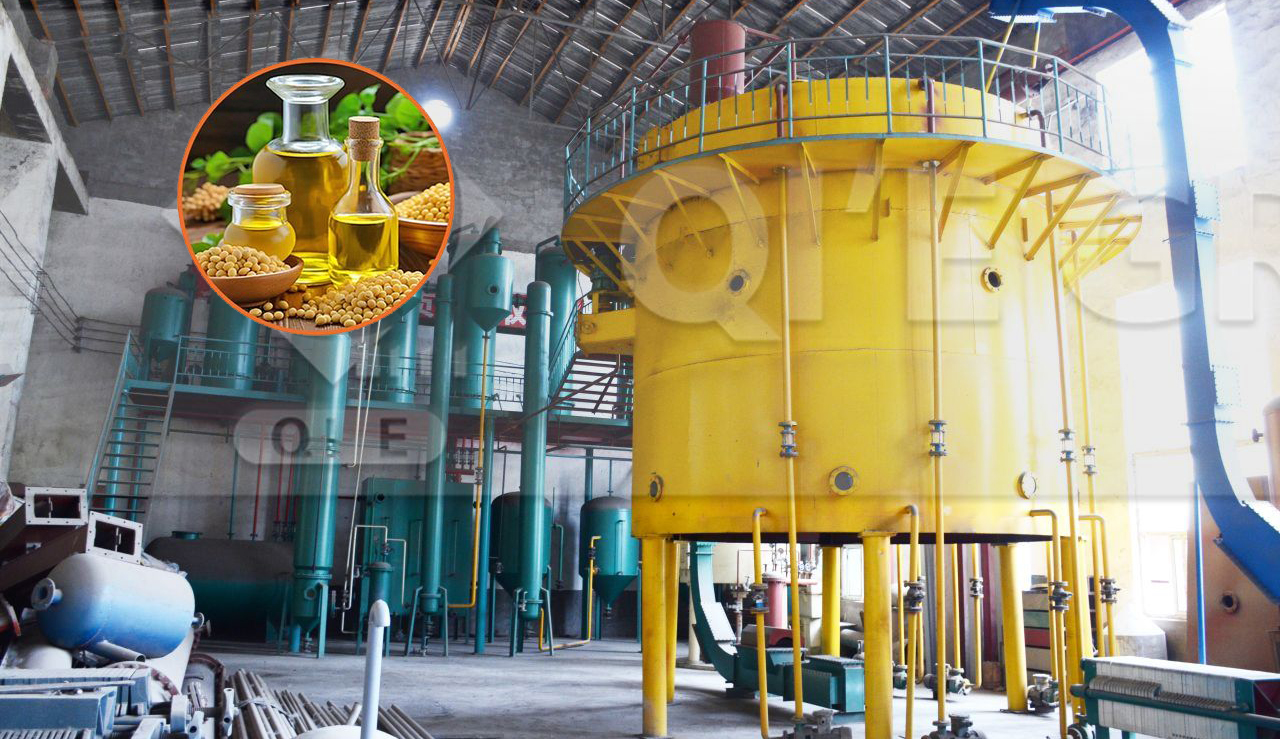
Why Invest in Soybean Oil Production in Zambia?
1. Strong Raw Material Availability
Zambia has become an important soybean-producing country in Southern Africa, creating opportunities for local processing.
2. Growing Edible Oil Demand
Local production can reduce dependence on imported cooking oil.
3. Multiple Revenue Streams
Investors can sell:
- Cooking oil
- Soybean meal
- Animal feed products
4. Regional Market Potential
Processed soybean products can supply neighboring markets in Southern Africa.
A soybean oil production line in Zambia can be developed from a small oil pressing workshop to a fully integrated soybean crushing and refining factory. The best plant design depends on soybean supply, target market, investment budget, and desired production capacity. For most commercial investors, a 20–100 TPD soybean oil processing plant provides a practical balance between investment cost, production efficiency, and market opportunity. QIE Group provide various capacity soybean oil production line, if you want to build in a soybean oil processing plant in zambia, please contact us!
FAQ
Why is Zambia suitable for a soybean oil production line?
Zambia is suitable for soybean oil production because of its soybean farming potential, available agricultural land, and growing demand for edible oils. Soybean processing also creates additional income from soybean meal, which is widely used in livestock and poultry feed.
What products can be produced from a soybean oil plant in Zambia?
A complete soybean oil production line can produce:
Refined soybean cooking oil
Crude soybean oil
Soybean meal/cake for animal feed
Soybean hulls and other by-products
The soybean meal generated after oil extraction is an important secondary product because of its high protein content and demand from feed manufacturers.
Can soybean oil production be combined with a feed mill?
Yes. Many soybean processing projects integrate:
Soybean crushing plant
Oil extraction line
Soybean meal processing
Animal feed production
This improves profitability because both cooking oil and high-protein feed products can be sold.
What are the primary methods used to extract soybean oil?
There are two main methods: Mechanical Pressing (best for small to medium setups, yielding around 85% of the oil) and Solvent Extraction (chemical method using N-hexane, which is highly preferred for large industrial plants to squeeze maximum oil out of low-oil-content seeds like soybeans).
What equipment is needed for an oil refinery section?
To turn crude oil into safe, clear, and odorless cooking oil, you will need a heat conduction oil furnace, a steam generator, refining pots (for degumming), a decolorizing pot, and a deodorizing pot.
What can I do with the waste material left after oil extraction?
The leftover material is called soybean oilcake or soya meal. Because soybeans are incredibly rich in protein, this byproduct is in high demand across Zambia as a primary ingredient for manufacturing poultry and livestock feed. Some advanced production lines even integrate a steam-conditioned extruder to turn this meal into soya chunks for human consumption.
What information is needed for a soybean oil plant quotation?
To design a suitable soybean oil production line, investors should provide:
Required capacity (TPD)
Factory location in Zambia
Available soybean quantity
Desired products (crude oil, refined oil, meal)
Extraction method preference
Automation level
Land and utility conditions